
First Step Act and Pickaway Correctional Institution: Recidivism and Prison Reform
Introduction
The criminal justice system is one of the most intricate areas, and it involves many acute issues that need to be resolved. To improve the system, the First Step Act was ratified in 2018. The Act includes several provisions on recidivism-reduction initiatives, prison programming, punishment, and reentry protocols (James, 2019). The Act aims not simply to reduce the incidence of recidivism but additionally to improve prison conditions for inmates, ensuring fair treatment and better opportunities for individuals.
The purpose of the paper is to demonstrate the essence of the First Step Act and use the example of Pickaway Correctional Institution (PCI). PCI is a medium-security male prison with Level 1 (minimum) and Level 2 (medium) security inmates (Correctional Institution Inspection Committee, 2023). Only 2.5% of those behind bars are Level 3 (close) security inmates (Correctional Institution Inspection Committee, 2023). The Act had a significant impact on correctional facilities, especially PCI, where recidivism rates improved and fair treatment practices are becoming more prevalent despite persistent challenges.
Act’s Impact and Its Degree of Influence
It is vital to note that the Act has a significant impact on correctional facilities. According to a report from the Ohio Department of Rehabilitation and Corrections (2021), 32.7% of people who are released from prison are detained again within three years. That works out to be roughly 7,000 of the over 20,000 prisoners that Ohio releases each year (Ohio Department of Corrections, 2021).
Before the enactment of the Act, 57.62% of prisoners released from Pickaway Correctional Institution in 2016 were placed under control, 2 percentage points higher than in 2015 (Ohio Department of Corrections, 2021). While it was as low as 41% in 2010, the figure has remained above 50% since 2012 (Ohio Department of Corrections, 2021). However, with the establishment of the policy, changes were made to the correctional facilities.
When delving deeper, the Act helped PCI create rehabilitation and reentry programs, as well as support networks, to reduce recidivism. PCI maintained a sizable “One-Stop Shop” where inmates could obtain essential paperwork to prepare for release from prison (Correctional Institution Inspection Committee, 2023). Additionally, they had 10 Ohio Means Jobs computers where people could build portfolios and resumes, along with all the necessary paperwork, to prepare to apply for jobs (Correctional Institution Inspection Committee, 2023).
By collaborating with post-release organizations and other community organizations to bring in “role models,” staff members observed that PCI increased access to reentry programming (Correctional Institution Inspection Committee, 2023). Employees observed that facility management played a crucial role in establishing these alliances (Correctional Institution Inspection Committee, 2023). Therefore, one can see that although the incidence of recidivism is not changing drastically, the Act contributed to efforts to diminish it.
Implementing Correctional Reforms
Moving on, it is also helpful to discuss the correctional reforms PCI implemented to improve efficiency in addressing recidivism and prison conditions. For this purpose, the facility has a risk and needs assessment system. According to the Act, the Bureau of Prisons (BOP) must design a system for the Department of Justice (DOJ) to use to evaluate the likelihood that federal inmates will reoffend and to place them in productive pursuits and evidence-based recidivism-reduction programs (James, 2019).
After the First Step Act is passed, the DOJ has 210 days to develop and implement the system (James, 2019). Each inmate’s risk of repeat offenses will be assessed during the initial intake phase, and they will be categorized as having a minimum, low, medium, or high risk (James, 2019). In such a case, such a framework allows the facility to track the progress and determine whether there are gaps in its approaches.
Moreover, the system ensures that the facility can address inmates’ individual needs. In accordance with the Act, the system must offer recommendations on the type, quantity, and level of recidivism-reduction programming and beneficial endeavors assigned to each incarcerated individual (James, 2019). This includes details on the initiatives inmates should participate in and on how the BOP can customize programs to meet each prisoner’s unique criminogenic needs to lower their risk of recidivism (James, 2019). To reduce recidivism, the system must also offer guidance on allocating housing and on participating in programs that group inmates with comparable risk levels when feasible (James, 2019). Therefore, by considering the needs and interests of the prisoners, it can be feasible to reduce recidivism rates.
Reducing Recidivism
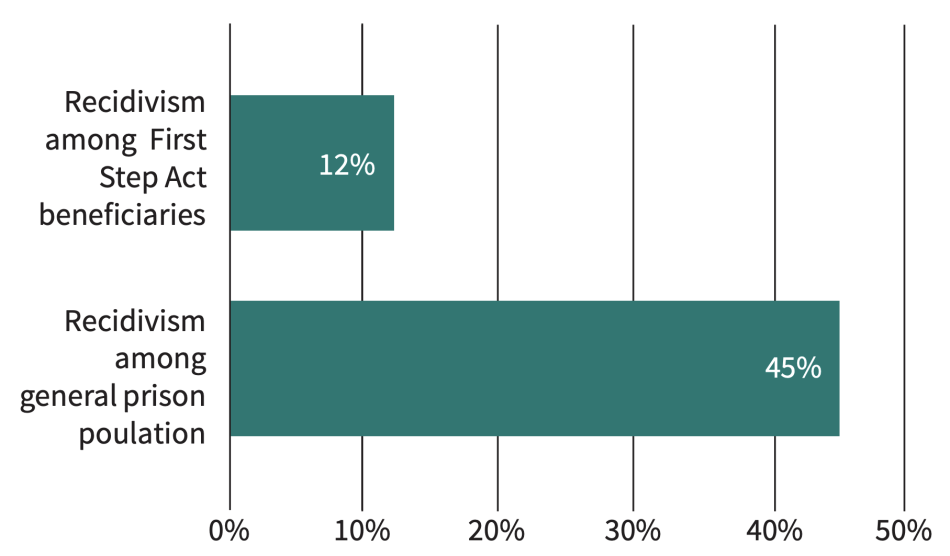
Furthermore, after analyzing the reports associated with the Act, it is evident that progress has been made across all facilities. As shown in Figure 1, compared with those released from imprisonment without the Act’s benefit, those who have benefited from it exhibit a far lower recidivism rate. Almost 9 out of 10 of the nearly 30,000 people whose release was accelerated by the First Step Act have not been detained or returned to jail (Nellis & Komar, 2023).
The more usual 45% recidivism rate for those released from federal jails stands in stark opposition to this 12% rate (Nellis & Komar, 2023). Of those freed as a result of the First Step Act, the majority (58%) were serving sentences related to drug trafficking offenses (Nellis & Komar, 2023). Moreover, 13% of these individuals have been detained or imprisoned again since being released (Nellis & Komar, 2023). In contrast, 57% of those freed from state custody after being found guilty of drug trafficking returned to their previous crimes within three years (Nellis & Komar, 2023). Therefore, the Act can be viewed as a beneficial intervention that can help mitigate the issues connected to recidivism.
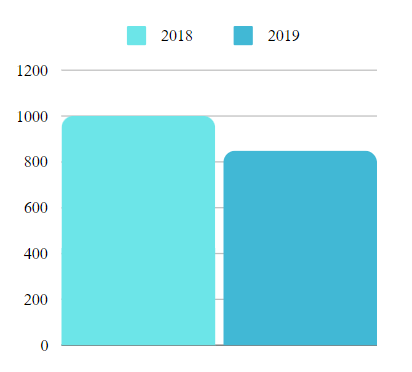
Official reports show that the number of those charged with severe penalties has decreased significantly. For instance, because the First Step Act narrowed the list of qualifying prior drug offenses, fewer offenders were subject to the enhanced recidivist penalties during the first year of the program (United States Sentencing Commission, 2020). As seen in Figure 2, criminals who received enhanced punishments fell by 15.2%, from 1,001 in the fiscal year 2018 to 849 in First Step Year One (United States Sentencing Commission, 2020). Therefore, as the statistics show, the Act contributes to improvements in the criminal justice system.
Improving Jail Conditions
Finally, as said earlier, the Act has several aims. The First Step Act aims to improve conditions in federal prisons and reduce excessively lengthy federal sentences (Grawert, 2020). The two ways that the prison reform provisions of the law aim to enhance conditions inside federal prisons are as follows (Grawert, 2020).
One is by putting an end to brutal practices, involving encouraging inmates to be housed in prisons nearer to their families and eliminating the use of restraints on expectant mothers (Grawert, 2020). The alternative is to refocus prisons on rehabilitation rather than punishment. To effectively expand rehabilitation services in federal prisons, Congress and the Department of Justice will need to take significant action (Grawert, 2020). Thus, the legislation demonstrates the need to focus on inmates’ needs and interests.
PCI reports show that safety and security, along with fair treatment practices, are improving, but challenges persist. For example, as shown in Figure 3, the rate of prisoner satisfaction increased slightly. PCI’s violence metrics are lower than those of similar institutions despite a notable increase in violent convictions from 2019 to 2020 (Correctional Institution Inspection Committee, 2021). Still, incidents involving the use of force rose significantly between 2019 and 2020 (Correctional Institution Inspection Committee, 2021).
Additionally, compared to earlier surveys, survey participants reported higher rates of harassment (Correctional Institution Inspection Committee, 2021). In addition, compared with earlier surveys, survey participants expressed greater dissatisfaction with staff exchanges (Correctional Institution Inspection Committee, 2021). Therefore, although slight changes are evident, many aspects still need to be addressed.

Conclusion
In summary, the Act had a major effect on prisons, particularly PCI, where, despite ongoing difficulties, the recidivism rate is declining and equitable treatment practices are becoming more common. Although there has not been a significant change in the recidivism rate, the Act helped reduce its impact. Finally, PCI reports demonstrate how fair treatment practices, safety, and security are improving, but problems still exist. Participants in the survey expressed more dissatisfaction with staff exchanges and the frequency of harassment than in previous surveys.
References
Correctional Institution Inspection Committee. (2021). Summary of the inspection and evaluation of Pickaway Correctional Institution.
Correctional Institution Inspection Committee. (2023). Report on the inspection and evaluation of Pickaway Correctional Institution.
Grawert, A. (2020). What Is the First Step Act — And what’s happening with it? Brennan Center for Justice.
James, N. (2019). The First Step Act of 2018: An overview. Congressional Research Service.
Nellis, A., & Komar, L. (2023). The First Step Act: Ending mass incarceration in federal prisons. The Sentencing Project.
Ohio Department of Corrections. (2021). Recidivism report.
United States Sentencing Commission. (2020). The First Step Act of 2018: One year of implementation.
